
You stay calm. You explain. You get down to their level and name the feeling.
You do everything the gentle, thoughtful way.
And your child still argues, still pushes, still melts down.
So you reach the conclusion most caring parents reach:
I must not be doing it well enough. I need better words. I need to stay calm a little longer.
But that isn't what's happening. You're not too harsh. You're not careless. You're a parent trying very hard to get this right. And that's exactly why it feels so confusing.
When calm parenting stops working, it doesn't fail loudly. It fails quietly.
You're not yelling. You're not punishing. Instead, you're explaining the same limit one more time, negotiating "just this once", giving in because another fight feels worse, feeling guilty the moment your child gets upset.
From the outside, it looks gentle. From the inside, it's exhausting. And to your child, it feels unsteady.

When children push back, most advice points at the behavior: tantrums, defiance, not listening. So you try the two things that feel right.
First, you try harder. More patience, more calm, more staying regulated. But effort was never the missing piece. Trying harder inside the same setup doesn't change the result. It just leaves you more tired.
Then you try to understand more. More explaining, more reasons, more talking it through. But to a child in a hard moment, explaining sounds like one thing: this is still open for discussion. Every reason opens another round. Not because your child is manipulative. Because the limit doesn't feel settled.
Both roads fail for the same reason.
This isn't a behavior problem. It's a structure problem.
Calm without structure doesn't feel safe to a child. It feels uncertain. And uncertainty is exactly what makes a child push.
Children don't respond to calm. They respond to steadiness. Calm is an emotional state. Steadiness is a structure. It's decisions that don't change because emotions get louder. Limits that stay in place when feelings rise.
Calm is what you feel. Steadiness is what you build.
From the outside, you see behavior: arguing, crying, pushing, refusing. Inside your child, something very different is happening.
A child's nervous system has one job: to work out what's safe. It doesn't weigh your logic. It doesn't read your good intentions. It reads patterns.
When the limit moves, depending on how tired you are, how upset they are, how long they argue, the brain receives one message: there is no solid ground here.
And when the ground feels unstable, the part of the brain that scans for danger stays switched on. So your child isn't just "being dramatic." Their body genuinely doesn't know what comes next. So they push. Not to be difficult. To find something that holds still.
Testing isn't misbehavior. It's how a child checks if the ground is solid.
This is why children in warm but structurally unclear homes often seem restless, clingy, controlling, or thrown by small things. They don't experience the missing structure as freedom. They experience it as being alone with something too big to manage.
A child can't steady themselves from the inside yet. They borrow it from a steady adult. When that steadiness is there, their system can finally settle. When it's missing, the brain learns to stay on alert. That's how anxiety gets built.

It's tempting to think: I understand this now. I'll deal with it later. But "later" has a price, paid in both directions.
Every week, your child's brain learns a little more firmly: if I push long enough, the limit moves. If I cry harder, it softens. These pathways don't fade on their own. They deepen, because the brain is simply learning what works.
At the same time, your own nervous system is learning too: setting a limit leads to conflict. Conflict is exhausting. Avoid it if you can. So you hesitate a little more. You give in a little faster. The loop tightens on both sides.
The pattern doesn't pause while you wait. It practices.

My name is Katy Quinn. This didn't begin with confidence or a theory. It began with frustration.
I was the parent who tried almost everything online. The gentle scripts. The calm voice. The endless explaining. I followed modern parenting advice closely, because I truly wanted to get it right. And our home only grew more tense. Limits felt fragile. Every decision came with doubt. I was constantly afraid that saying "no" would damage my child.
That gap between doing everything "right" and still watching it fall apart is what pushed me to stop collecting opinions and go find foundations. I earned a Master's in Child Development. There I studied how children actually develop: how emotional regulation forms, why self-control lags so far behind language and reasoning, and why a steady, consistent adult matters more than any perfect explanation when a child is overwhelmed.
That includes John Bowlby's work on how children build safety through a reliable adult. And Diana Baumrind's finding that children do best not with control, and not with permissiveness, but with warmth and structure together.
I didn't want more opinions. I wanted foundations.
You've just seen what's going wrong, and why. But understanding has a limit. I'd rather you feel this work than take my word for it. So here are two tools, taken straight from The Boundary System.
Tool 1 — Steady yourself first (30 seconds)
You can only pass on the calm you actually have. Before you do anything with your child, do this:
- Stop. Say nothing, take one breath.
- Body. Drop your shoulders, breathe out slowly, unclench your jaw.
- Thought. Tell yourself: "He is a child. I am the adult. I can handle this."
- Then speak. Say the limit calmly — or give yourself a moment: "I'll talk in a minute."
Tool 2 — When your child melts down
The tablet just went off and your child explodes. Here's the sequence:
- Steady yourself first.
- Make it safe. Move aside, take away anything that can hurt.
- Name the feeling. "You're angry. You really wanted to keep playing."
- Say the limit once. "The screen is off now."
- Stay close, don't give in. "This is hard. I'm right here."
- Come back together after. "You made it through. I love you."
Your child learns three things at once: my feelings are real, the limit still holds, and I am not alone.
Inside The Boundary System there's a matching sequence for every hard moment you're facing right now: bedtime, sweets, hitting, getting dressed, the meltdown in the middle of the store. Same structure, every situation.
You don't need more willpower in the moment. You need a sequence you can step into.
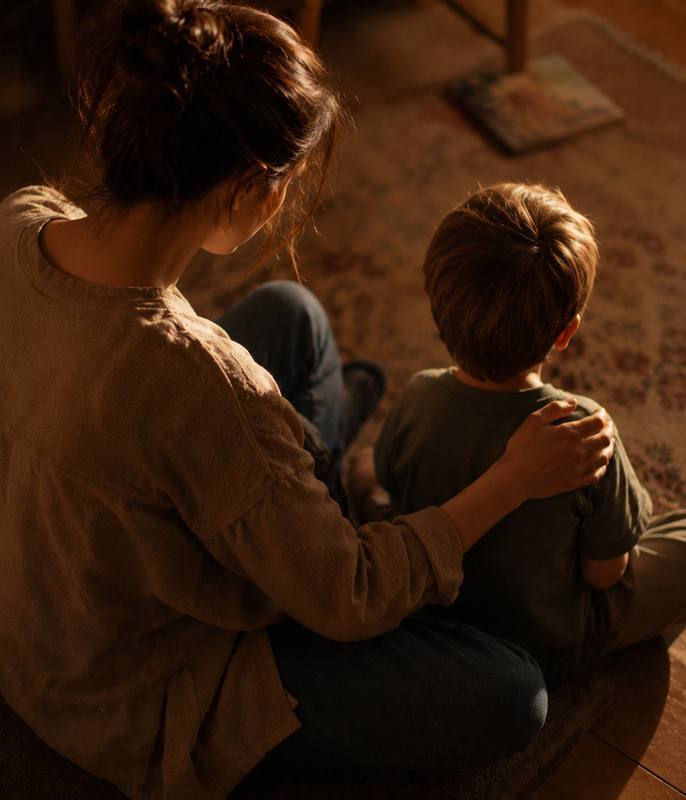
You've read the advice. You understand why it escalates. In a calm moment, you know exactly what to do.
And still, when you're tired, when the meltdown hits, when a decision has to happen in five seconds, the knowing vanishes. Fear takes over. You hesitate, you soften, you negotiate.
You already know what to do. It just disappears at 6:30 PM.
Not because you forgot. Because there was nothing solid to stand on when the pressure rose. Insight only works while you're calm. Structure works when your calm runs out.
That's the whole point of The Boundary System. It isn't more theory. It isn't a stricter version of you. It's a structure you can step into when you're tired, triggered, and unsure. The limit holds without harshness and without guilt.
Not because you became stricter. Because you became steady.
What you rehearse today, your child becomes in five years.
If the meltdown changes the outcome, they learn to push harder. If your "no" depends on your mood, they learn it doesn't really mean no. A calm, predictable limit teaches the opposite. And you're teaching something either way.
You don't need a perfect week. You need the next "no" to end differently.
What kind of parent are you right now?
Answer 6 quick questions. Get a diagnosis that's actually about you.
What's actually happening in your house right now?
When the boundary starts breaking down, what actually happens?
After you give in or lose it, what goes through your head?
Which one sounds most like you right now?
What scares you most when you think about this honestly?
What have you already tried?
Inside The Boundary System
- The full book: 13 chapters, built on attachment and child-development research, with a clear sequence for every hard moment from ages 2 to 10
- The Boundary Card: a one-page guide for exactly what to do and say in the moment
- Your First 7 Days: a simple quick-start plan, so you know precisely where to begin
- A step-by-step reset plan, by age, for when limits have been missing for years
Your only real risk is staying in the loop you're already in.
$29 $19 · Instant access · No subscription
Real messages from readers

The biggest change for me is inside. When my child melts down, I don't panic or feel like I'm failing anymore. I understand what's happening and why, and that makes it so much easier to stay calm and steady in the moment.

Katy omg. Tantrums used to feel like emergencies here. I'd either try to talk him out of it or I'd freeze and then feel guilty after. The way you explained what's actually happening in the nervous system changed everything for me. Now I can tell when it's overload vs just protest, and episodes got shorter. Honestly I'm less scared of them now.

I bought The Boundary System about a month ago and finished it slowly because I kept rereading parts. Screen time and bedtime are no longer daily explosions. The biggest thing is I don't feel lost anymore. I know what I'm holding and why.

I didn't realize how unclear I was until I read this. I thought I was being gentle, but I was actually confusing my kids. After a few weeks of holding things more steadily, they push back less and our days don't feel so chaotic.

This book helped me stop feeling like I had to choose between being kind and being firm. That belief was exhausting me. Now I see how boundaries can actually be loving, and that changed the way I show up with my kids almost immediately.

I was very doubtful when ordering. I thought it might be one more of those things we all know but struggle to put in action. BUT it was actually very helpful. To the point, with constant reminders that it's a process. It really helped to know we can change one thing at a time.
$29 $19 · 13 chapters · The Boundary Card · Your First 7 Days · Age reset plan

Children don't grow out of testing. They grow into the pattern you practice with them every day.
Show me The Boundary System →$29 $19 · Instant access · No subscription
